
Baccarat Rules, Card by Card
In baccarat you back one of two hands — Player or Banker — and the one finishing nearer nine takes the round. The hands are not yours to play: the dealer follows set rules, so your only call is the box you back and the size of the stake.
Here is how to play baccarat in five steps:
- 1Bet on Player, Banker or Tie.
- 2The dealer gives two cards each to Player and Banker.
- 3If either hand has 8 or 9 (a “natural”), the round ends.
- 4Otherwise, a third card may be drawn by fixed rules.
- 5The hand closer to 9 wins; equal totals are a Tie.
What Kind of Game Is This?

Few casino games have survived this long. The version in nearly every online and brick-and-mortar house is Punto Banco — and that is what people usually mean by “baccarat.”
Poker and blackjack ask you to act; baccarat asks you to choose and then step back. “Player” and “Banker” name the two hands — not you, not the house. Back either one or the Tie, and let the cards settle it.
Card Values: Why a Ten Counts as Zero
Each card has a fixed point value:
| Card | Points |
|---|---|
| 2 to 9 | face value |
| 10, Jack, Queen, King | 0 |
| Ace | 1 |

A hand’s score is the last digit of its total. If the cards add up to 10 or more, you drop the tens:
- 7 + 8 = 15 → 5 points
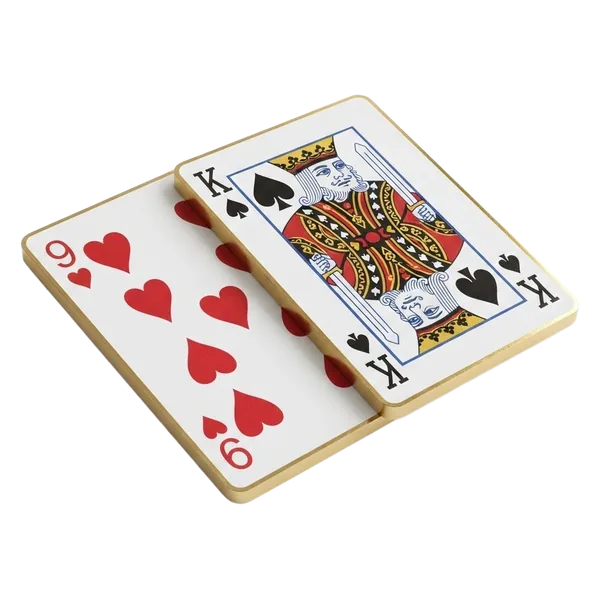
- King + 9 = 9 → 9 points
- 6 + 6 = 12 → 2 points
- Ace + 10 = 1 → 1 point
Busting, as blackjack players know it, cannot happen here: nine is the ceiling. A two-card total of eight or nine is a natural, and it closes the round on the spot.
- K + 9 = 9a natural nine — the top hand
- 5 + 3 = 8a natural eight
The round ends at once — no third card is dealt.
How a Round Unfolds
Every round follows the same order:
- 1You place your bet on Player, Banker, Tie, and any side bets.
- 2The dealer deals two cards to Player and two to Banker, alternating.
- 3If either hand has a natural 8 or 9, both hands stand and the round is settled.
- 4If there’s no natural, the Player hand draws or stands by the third card rules.
- 5Then the Banker hand draws or stands, using the same rules.
- 6The hand with the higher score wins. Equal scores are a Tie.

Most games use a shoe of eight decks, shuffled together. Some tables use six. The number of decks barely changes the odds, as our baccarat odds page shows.
Reading the Table Layout

A full-size baccarat table seats up to 14 players around an oval layout, while a mini baccarat table looks like a blackjack table with seven seats. Online, you’ll see a simplified version of the same layout.

Every table has the same key areas: betting boxes for Player, Banker and Tie; smaller boxes for side bets such as Player Pair and Banker Pair; a commission area where the dealer tracks the 5% owed on Banker wins; the shoe that holds the cards; and a discard tray. Live tables add a scoreboard showing the history of recent rounds.
The Third-Card Rule: A Decision Made For You

The third-card rules govern who draws and when. The good news: you never apply them yourself — the dealer or the software does. Still, knowing them makes the table far easier to follow.
When the Player Draws

| Player’s two-card total | Action |
|---|---|
| 0–5 | Draws a third card |
| 6–7 | Stands |
| 8–9 | Natural — round ends |
When the Banker Draws
If the Player stood on two cards, the Banker follows the same rule: draws on 0–5, stands on 6–7. If the Player drew a third card, the Banker’s move depends on its own total and on the Player’s third card:

| Banker’s total | Draws when Player’s third card is | Stands when Player’s third card is |
|---|---|---|
| 0–2 | any card | — |
| 3 | anything except 8 | 8 |
| 4 | 2–7 | 0, 1, 8, 9 |
| 5 | 4–7 | 0–3, 8, 9 |
| 6 | 6–7 | 0–5, 8, 9 |
| 7 | — | always stands |
A “0” in the table means a 10 or a face card.
Bets, Payouts and the Commission

There are three main bets, plus optional side bets. In an 8-deck game the numbers look like this:
| Bet | Payout | Win probability | House edge |
|---|---|---|---|
| Banker | 1 to 1 minus 5% commission | 45.86% | 1.06% |
| Player | 1 to 1 | 44.62% | 1.24% |
| Tie | 8 to 1 | 9.52% | 14.36% |
| Player Pair / Banker Pair | 11 to 1 | 7.47% | 10.36% |
If the result is a Tie, bets on Player and Banker are returned (a push). That’s why the win probabilities for Player and Banker don’t add up to 100%.
Where the Five Percent Comes From

Banker comes out ahead slightly more often — 45.86% of rounds to Player’s 44.62% — simply because it acts last under the third-card rules. Without a fee, that small informational edge would tilt the game toward the player. The 5% commission restores the balance, and Banker remains the strongest bet on the felt.
Some tables drop the commission and instead pay only half on a Banker win with 6. That raises the house edge on Banker to about 1.46%. See baccarat variants for details.
Two Hands, Start to Finish
Hand 1: a natural nine. You bet $10 on Player. Player gets a King and a 9: 0 + 9 = 9, a natural. Banker has 4 and 3, which is 7. No more cards are drawn. Player wins with 9 against 7, and you collect $10 in winnings plus your $10 stake.
Hand 2: the Banker draws. You bet $10 on Banker. Player has 2 and 3, which is 5, so Player draws: a 6 makes 11, which counts as 1. Banker has 3 and 2, which is 5. With 5, Banker draws when the Player’s third card is 4–7 — here it’s 6, so Banker draws a 2 for a total of 7. Banker wins 7 against 1, and you get $9.50 ($10 minus the 5% commission) plus your stake.
Baccarat or Blackjack?

Both are card games with a low house edge, but they feel very different.
| Baccarat | Blackjack | |
|---|---|---|
| Player decisions | none after the bet | hit, stand, double, split |
| Can you bust? | no, the maximum is 9 | yes, over 21 |
| Best house edge | 1.06% (Banker) | about 0.5% with perfect basic strategy (6–8 decks, 3:2 blackjack) |
| Learning curve | minutes | hours to master basic strategy |
| Pace | fast, especially Speed Baccarat | slower, depends on decisions |
If you want a game you can play well right away, baccarat is easier. Blackjack can offer slightly better odds, but only if you play every hand correctly.
The Wider Family


The rules on this page apply to Punto Banco, the standard version. Other variants change the commission, the pace or the side bets:
- Mini Baccarat — the same rules at a smaller table with lower limits.
- Chemin de Fer — players take turns as the bank and can choose to draw on 5.
- No Commission / Super 6 — no 5% fee, but Banker wins with 6 pay half.
- EZ Baccarat — no commission; a Banker win with a three-card 7 is a push.
- Speed Baccarat — live rounds of about 27 seconds.
- Squeeze — cards are revealed slowly for drama.
All of them are explained on our baccarat variants page.
Online or Brick-and-Mortar

| Online (RNG) | Live dealer | Land-based casino | |
|---|---|---|---|
| Cards | random number generator | real cards in a studio | real cards |
| Round length | a few seconds | about 30–50 seconds | a minute or more |
| Minimum bet | from $0.10 | from $0.50 | usually higher |
| Free demo | yes | usually no | no |
| No-commission tables | common | common | less common |
Online RNG tables are the best place to learn. You can even try them for free in demo mode.
What the Dealer Actually Does

In a casino, the dealer handles everything. They deal cards from the shoe in a fixed order — Player, Banker, Player, Banker — apply the third card rules, announce the result, pay winning bets and track the commission owed on Banker wins.
At high-limit tables, the player with the biggest bet may be allowed to reveal the cards. That’s why you sometimes see players bending or slowly peeling cards: it’s the squeeze, a tradition from Asian casinos. Because of it, land-based casinos replace the cards after each shoe.
A Short, Contested History

Where baccarat began is still argued over. The popular account traces it to fifteenth-century Italy; from there it crossed into France and became an aristocratic pastime, Chemin de Fer being its best-known shape.

Ian Fleming made it famous worldwide in Casino Royale (1953), where James Bond plays Chemin de Fer. Punto Banco, the version where the casino holds the bank, spread to Las Vegas in the mid-20th century. Today baccarat is the leading casino game in Macau and one of the most popular live casino games online.
Five Costly Beginner Mistakes

- 1Betting on Tie for the 8 to 1 payout. Its house edge is 14.36%, more than 13 times the Banker bet’s.
- 2Avoiding Banker because of the commission. Even with the 5% fee, it is the best bet in the game.
- 3Making side bets your main bet. Most side bets have a house edge of 7–10% or more.
- 4Following patterns on the scoreboard. Every hand is independent; past results don’t predict the next one.
- 5Chasing losses. Raising your bets to win back money is the fastest way to lose more. Set a budget and stick to it.
If you’re looking for “how to play baccarat and win,” the honest answer is to avoid these mistakes: there is no way to beat the house edge over time. Our baccarat strategy guide explains what you can and can’t control.

Frequently Asked Questions
You back Player, Banker or Tie. Each hand takes two cards, occasionally a third under fixed rules, and the closer to nine wins. After the bet, nothing is asked of you.
Most tables run an eight-deck shoe; some use six. The deck count moves the odds by a sliver of a percent.
Eight or nine on two cards. Once a natural appears, no further cards are dealt and the round is settled.
No. Dealer or software applies them automatically — knowing them only helps you read the table.
Your bet wins if the hand you backed lands closer to nine. Over many hands no staking method beats the edge; backing Banker just keeps that edge as low as it goes.
Live tables show past results on scoreboards called roads. Red usually marks Banker wins, blue Player wins and green Ties. Our live baccarat guide explains each road.
That is the squeeze: the biggest bettor peels the cards back for suspense. The result is unaffected. Bent cards go straight into the bin after each shoe.

 Sergey MelnikovEditor and moderator

Test the Rules at a Table
Play a handful of demo rounds — the third-card rule lodges in memory faster than any chart.